

Start with the square footage baseline
Start by defining what a good Estimate Construction Cost for a New Home purchase has to prove before you compare prices. Separate must-have requirements, seller credibility, condition, delivery timing, and return terms from nice extras that can wait. Keep the first pass narrow. Shortlist a few credible sources, check the evidence behind each listing, and reject options that hide basic details. A cheaper offer is not useful if it leaves the most important risk unanswered.
The simplest way to use this section is to verify the seller, compare the total cost, and resolve the biggest risk before you commit.
Adjust for your specific location
National averages provide a starting point, but they rarely reflect the actual cost to build a new home in your specific county. The national baseline hovers around $162 per square foot, but local variables like labor availability, zoning laws, and material transport distances can shift that number significantly. To get a realistic estimate, you must move from the national average to your local reality.
1. Identify your regional cost tier
Construction costs vary wildly across the United States. A home that costs $162 per square foot in the Midwest might cost $250 or more in the Northeast or West Coast due to higher labor rates and stricter building codes. Start by identifying which tier your location falls into. Use the comparison below to see how your region stacks up against others.
| Region | Low Cost ($/sq ft) | High Cost ($/sq ft) | Key Drivers |
|---|---|---|---|
| South & Midwest | $140 | $180 | Lower labor costs, less stringent zoning |
| Northeast | $200 | $350+ | High labor rates, complex soil conditions |
| West Coast | $220 | $400+ | Earthquake codes, high material transport |
| Mountain West | $170 | $280 | Remote sites, seasonal labor shortages |
2. Account for local labor and material markups
Labor is often the biggest variable. In high-demand areas, contractors charge a premium because they are booked months in advance. Similarly, if your site is remote, material transport fees can add 10-20% to your total bill. Check local union rates and ask builders for their current "hard cost" estimates, which exclude land and soft costs. This gives you a clearer picture of what it actually costs to pour the foundation and frame the walls in your zip code.
3. Check zoning and permit fees
Local government fees can add thousands to your budget without adding visible value to the home. Some jurisdictions charge high impact fees for schools or roads, while others have complex environmental review processes that delay start dates. A delayed start means higher interest costs on your construction loan. Call your local building department to ask for a fee schedule before you finalize your budget.
Use the regional comparison above to set a rough per-square-foot range. Adjust this number based on whether your area is high-demand or rural.
Contact at least three local builders. Ask for a detailed breakdown of labor and material costs specific to your lot size and design.
Visit your local building department website or office. Add the estimated permit fees, impact fees, and utility connection costs to your total.
Common location-based mistakes
- Ignoring transport costs: If you are building in a rural area, assume materials will cost more to deliver.
- Underestimating labor: In tight labor markets, builders may add a 15-20% contingency for delays.
- Skipping permit checks: Unpermitted work can lead to fines or issues when you sell the home later.
By adjusting your national baseline for these local factors, you will avoid budget surprises and build a more accurate construction cost estimate.
Break down material and labor lines
Rough guesses lead to budget overruns. To estimate construction cost accurately, separate the two largest drivers: labor and materials. This separation lets you adjust for local market rates and material quality without guessing blindly.
Start with the baseline. The National Association of Home Builders (NAHB) tracks detailed percentage breakdowns for typical homes. Use their data as your anchor. For a standard build, labor often accounts for 40–50% of the total, while materials make up the remaining half. If you have a specific square footage target, apply the current average cost per square foot—often cited around $162 per sq ft for basic construction, though this varies widely by region.
Adjust for location. Labor costs differ significantly between urban centers and rural areas. A carpenter in San Francisco commands a different wage than one in Ohio. Similarly, material shipping costs add up if you are building far from suppliers. Check local union rates or general contractor bids in your specific zip code to refine the labor portion of your estimate.
Check for common mistakes. Many first-time builders forget to account for waste. Materials like lumber, drywall, and tile typically have a 10–15% waste factor. If you are upgrading finishes, such as switching from builder-grade cabinets to custom wood, the material line item will shift dramatically while labor remains relatively stable. Keep these categories distinct so you can swap items without breaking your entire budget.
Account for permits and soft costs
Your baseline construction estimate covers the physical structure, but it rarely accounts for the administrative and professional layers required to build legally. These "soft costs" typically add 10-20% to your total project budget. Ignoring them is the most common reason homeowners exceed their initial financial projections.
Start by listing every professional fee. Architectural design, engineering stamps, and surveying services are non-negotiable for a custom build. Eisenmann Architecture notes that residential construction costs generally range from $700 to $1,200 per square foot, but this figure often excludes the preliminary design phase. Budget separately for these professional services before applying the multiplier to hard construction costs.
Next, calculate municipal fees. Permit costs vary significantly by jurisdiction but are calculated based on your project's valuation. You will also need to account for impact fees, which fund local infrastructure like schools and roads. These are often one-time payments due at the time of permit issuance.
Finally, include insurance and utility connections. Builder’s risk insurance protects the structure during construction, while utility hookup fees for water, sewer, and electricity can run into the thousands depending on your lot's proximity to municipal lines. Use a checklist to track every line item until the final permit is issued.
Review common budget mistakes
Even a detailed estimate can derail if you overlook the hidden costs that inflate final bills. The average cost to build a new home ranges from $137,901 to $523,890, but these figures often exclude the messy realities of site work and material volatility. To keep your financial decisions grounded, you must look past the baseline square footage price and scrutinize the line items that typically get cut.
The most frequent error is underestimating site preparation. Grading, clearing, and connecting utilities to the grid are not optional extras; they are foundational costs. In rough terrain, site work alone can add tens of thousands to the total. Ignoring soil tests or permit fees until later stages leads to change orders that eat into your contingency fund.
Another common trap is locking in finish prices too early. Lumber and steel prices fluctuate, and luxury fixtures often have long lead times. If you budget for mid-range materials but decide on high-end finishes halfway through, the gap is rarely covered by a standard 10% contingency. Always price out your final selections before breaking ground.
Finally, verify that your estimator includes all soft costs. Architectural fees, engineering stamps, and impact fees are often listed separately or omitted entirely in quick online calculators. Ensure every line item is accounted for before signing the contract to avoid unexpected invoices during the build.
Finalize your construction cost estimate
Before breaking ground, compile your data into a single budget. Start with the baseline cost per square foot—around $162 in 2026—and adjust for your specific location and lot conditions. Break down costs by trade (foundation, framing, mechanicals) to spot hidden expenses early.
Collect soil reports, survey maps, and utility access points. These factors heavily influence foundation and excavation costs. Without this data, your estimate will lack precision.
Choose exact materials for flooring, cabinetry, and fixtures. Upgrading from builder-grade to custom finishes can increase costs by 20–30%. Lock these choices in before finalizing the quote.
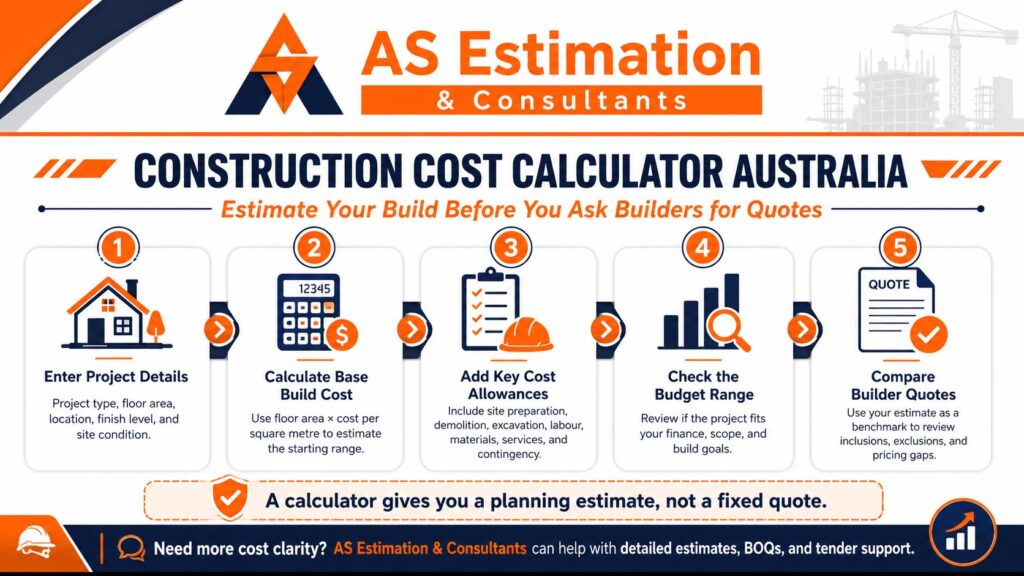
Get three detailed bids from licensed contractors. Compare line items carefully, not just the total price. A low bid often misses critical scope items like waste removal or permit fees.
Include a 10–15% contingency fund for unexpected issues like weather delays or material price spikes. This reserve prevents budget overruns when surprises inevitably arise during construction.
Frequently asked questions about home build costs
What is the average cost to build a new home?
The national average cost to build a new home sits around $162 per square foot for standard finishes. This baseline reflects a typical 2,647-square-foot single-family residence. However, total expenses often climb to approximately $195 per square foot once you factor in contractor fees, permits, and overhead. Expect a total project budget ranging from $137,901 to $523,890, depending heavily on your specific location and material choices.
How do location and labor affect construction estimates?
Labor and material costs vary significantly by region, often driving the final price well above the national average. High-cost metropolitan areas can push per-square-foot estimates significantly higher due to union labor rates and local supply chain constraints. When estimating, always adjust the base national average by your local cost index rather than relying on generic national figures.
What common mistakes ruin home build cost estimates?
The most frequent error in cost estimation is ignoring soft costs. Many builders focus solely on hard materials and labor, forgetting to include architectural fees, engineering reviews, permit expenses, and utility connection charges. These soft costs typically add 10-20% to your total budget. Another common mistake is failing to include a contingency fund for unexpected site conditions or material price fluctuations during the build.
No comments yet. Be the first to share your thoughts!