

What cost estimation actually means
Cost estimation is the structured process of forecasting the financial resources required to complete a project within a defined scope. It is not a single guess, but rather a calculated prediction based on historical data, current market rates, and the specific constraints of the work ahead. This discipline transforms vague project ideas into concrete financial plans, allowing teams to determine feasibility before committing capital.
It is critical to distinguish cost estimation from simple quoting. A quote is often a fixed price offered to a client, frequently padded with risk premiums to protect against uncertainty. Cost estimation, by contrast, is an internal analytical exercise. It seeks to determine the true baseline of what a project should cost, stripping away arbitrary markups to reveal the actual resource consumption. This distinction ensures that budgets reflect reality rather than fear.
Accuracy in this process matters because it directly influences financial health and stakeholder trust. Underestimating costs leads to budget overruns, delayed timelines, and strained vendor relationships. Overestimating can cause projects to stall due to perceived inefficiency or lack of funding. By grounding estimates in data and clear scope definitions, organizations make informed decisions about where to invest and where to pause.
Ultimately, effective cost estimation serves as the foundation for all subsequent project management activities. It provides the benchmark against which performance is measured, enabling teams to track variance and adjust strategies in real time. Without a reliable estimate, a project lacks the financial compass needed to manage execution complexities.
Four main methods for accurate estimates
Choosing the right cost estimation method depends on the data you have and the phase of your project. Early-stage projects rely on speed and high-level assumptions, while detailed execution requires precision. Selecting the wrong approach can lead to budget overruns or missed opportunities.
Analogous estimating
Analogous estimating uses historical data from similar past projects to predict current costs. It is the fastest method but also the least accurate. Project managers often use this during the initiation phase when detailed scope information is missing. For example, if a previous office building cost $200 per square foot, you might apply that rate to a new, similar structure. This approach works best when the new project closely mirrors previous ones in size, complexity, and location.
Parametric estimating
Parametric estimating calculates costs using statistical relationships between historical data and other variables. Unlike analogous estimating, which relies on broad comparisons, parametric models use specific unit rates. If you know that wiring a standard office costs $5 per square foot, you can multiply that rate by the total square footage to generate a more precise estimate. This method scales well with data availability but requires reliable historical metrics to function correctly.
Bottom-up estimating
Bottom-up estimating involves breaking the project down into individual work packages or components, estimating each one separately, and then summing them up. This is the most accurate but also the most time-consuming method. It is typically used during the planning phase when the scope is well-defined. While it demands significant effort to identify every cost driver, it provides a solid foundation for budget control and reduces the risk of hidden expenses.
Three-point estimating
Three-point estimating accounts for uncertainty by using three values: the most optimistic, the most pessimistic, and the most likely scenario. By averaging these values, often using a weighted formula like the PERT distribution, you get a more realistic range than a single-point estimate. This method is particularly useful for projects with high risk or limited historical data. It helps stakeholders understand potential variances and plan for contingencies.
| Method | Accuracy | Time Required | Best Use Case |
|---|---|---|---|
| Analogous | Low | Fast | Initiation phase, similar past projects |
| Parametric | Medium | Medium | Data-rich environments, unit-rate calculations |
| Bottom-up | High | Slow | Detailed planning, defined scope |
| Three-point | Medium-High | Medium | High-risk projects, uncertainty management |
Calculate your project budget now
Cost estimation starts with a clear scope. You need to know the size of the work, the unit cost of resources, and a buffer for the unexpected. This calculator helps you turn those basic parameters into a preliminary project budget.
Enter your scope size, the average unit cost, and your contingency percentage. The tool multiplies scope by unit cost to find the base estimate, then adds the contingency to give you a total. Use this as a starting point for more detailed planning.
2026 inflation and material trends
Static numbers fail in a shifting economy. When you build a budget today, you are not just estimating labor and materials; you are forecasting volatility. In 2026, the gap between initial estimates and final costs has widened due to persistent inflation and unpredictable supply chain disruptions. Relying on historical averages from three years ago will likely result in significant underestimation.
Material costs are particularly sensitive to these fluctuations. Steel, lumber, and specialized electronics do not move in lockstep with general inflation rates. A sudden tariff change or a logistics bottleneck can spike material prices by double digits in a single quarter. This means your cost estimation must account for dynamic pricing rather than fixed line items.
To mitigate this risk, estimators are moving toward contingency-heavy budgets and regular re-forecasting cycles. Instead of a single final number, projects now require a range of estimates that adjust as market conditions evolve. Ignoring these trends turns your budget into a guess rather than a plan.
The key is to treat inflation as a variable, not a constant. By integrating current market data into your cost estimation models, you create a buffer against the unexpected. This approach does not eliminate risk, but it makes your financial planning resilient to the economic noise of 2026.
Checklist for Reliable Estimates
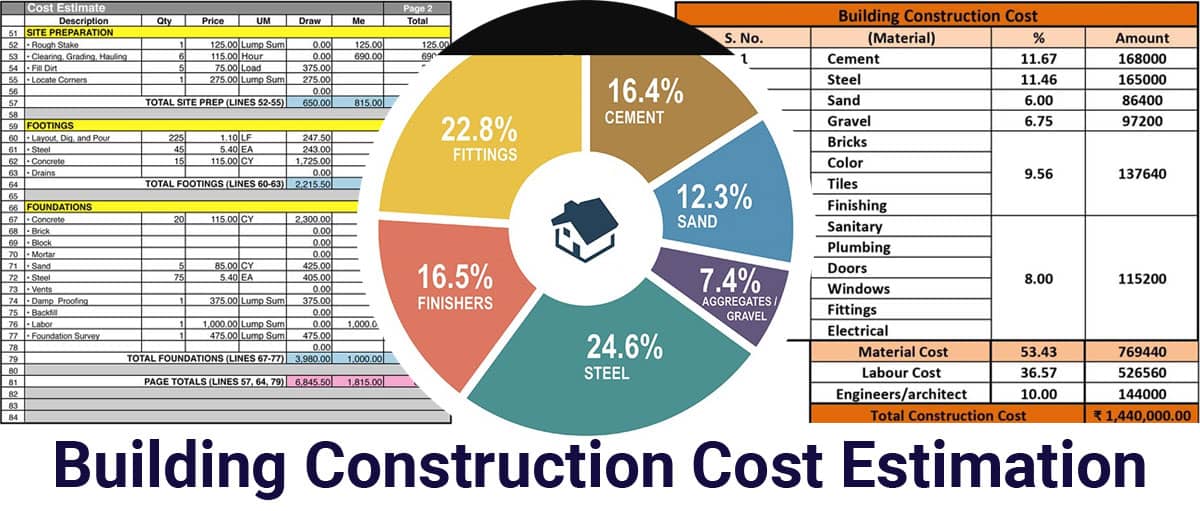
Before finalizing a budget, treat your cost estimate like a structural blueprint rather than a rough guess. A reliable cost estimation process requires verifying that every line item is backed by data, scope, and contingency logic. Use this checklist to catch common oversights before they become budget overruns.
Ensure every cost item maps directly to a defined deliverable. If a line item doesn’t serve the project scope, remove it. This prevents scope creep from inflating your baseline numbers without adding value.

Cross-reference unit prices with current market data or recent vendor quotes. Historical averages can be misleading; use real-time data for materials and labor to ensure accuracy.
Add a percentage buffer (typically 10-20%) for unknowns. This isn’t extra spending—it’s insurance against inflation, supply chain delays, or design changes that inevitably arise.
Don’t forget overhead, permits, insurance, and administrative fees. These often get overlooked in initial drafts but can account for 15-30% of total project costs.
List every assumption made during the estimate (e.g., labor rates, material availability). Clear documentation allows stakeholders to challenge or validate the basis of the numbers.
By following these steps, you transform a rough guess into a defensible financial plan. This discipline ensures that when you present your cost estimation to stakeholders, it withstands scrutiny and sets a realistic foundation for project success.
Common questions about cost estimation
Clarifying the basics of cost estimation helps teams avoid budget surprises before work begins. Below are answers to the most frequent questions about how these numbers are calculated and what they mean.
No comments yet. Be the first to share your thoughts!