
Understanding the True Cost of Home Construction in 2024
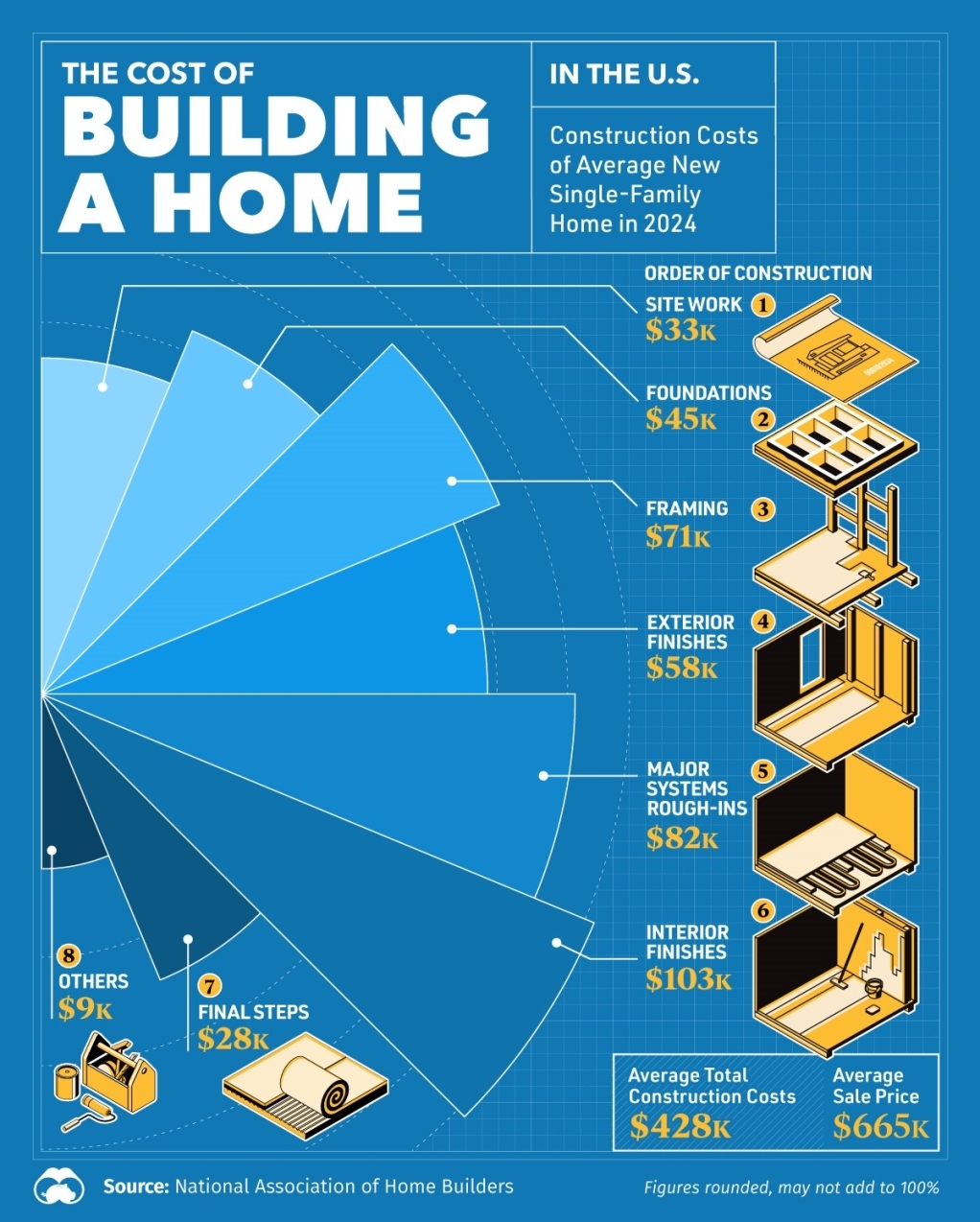
Building a home in 2024 has become significantly more expensive than in previous years, with the average construction cost reaching $428,215 for a single-family home in the United States. This represents a substantial 64.4% of the total average home price of $665,298, marking a notable increase from 2022 when construction costs accounted for 60.8% of home values.
This comprehensive guide will help you understand every aspect of home construction costs, providing reliable cost estimation methods and detailed breakdowns to help you make informed financial decisions about your building project.
The Current State of Construction Costs
The construction industry has experienced unprecedented cost increases due to various factors including material price volatility, labor shortages, and supply chain disruptions. Understanding these costs is crucial for accurate construction cost estimation and successful project planning.
The National Association of Home Builders (NAHB) data reveals that construction costs have outpaced general inflation, making it essential for prospective homeowners to have a clear understanding of where their money goes during the building process.
Major Cost Categories Breakdown
Home construction costs can be divided into eight primary categories, each representing a significant portion of your total investment:
2024 Home Construction Cost Breakdown by Category
The largest expense category is Interior Finishes at $103,391 (24.1% of total costs), followed by Major Systems Rough-ins at $82,319 (19.2%). These two categories alone account for nearly half of all construction expenses, highlighting the importance of careful planning in these areas.
Framing costs represent the third-largest expense at $70,982 (16.6%), while Exterior Finishes account for $57,510 (13.4%). Foundation work, despite being critical to structural integrity, represents a more modest $44,748 (10.5%) of total costs.
Detailed Cost Analysis by Construction Phase
2024 Home Construction Cost Breakdown by Category
| Construction Category | Average Cost | Percentage of Total | Cost Range |
|---|---|---|---|
| Site Work | $32,719 | 7.6% | $25,000 - $45,000 |
| Foundation | $44,748 | 10.5% | $35,000 - $60,000 |
| Framing | $57,510 | 13.4% | $45,000 - $75,000 |
| Major Systems | $68,515 | 16.0% | $55,000 - $85,000 |
| Interior Finishes | $89,965 | 21.0% | $70,000 - $120,000 |
| Exterior Finishes | $51,386 | 12.0% | $40,000 - $70,000 |
| Final Steps | $38,557 | 9.0% | $30,000 - $50,000 |
| Other Costs | $44,107 | 10.3% | $35,000 - $55,000 |
Site Work, which includes excavation, grading, and utility connections, accounts for $32,719 (7.6%) of total costs. This initial phase sets the foundation for your entire project and can vary significantly based on lot conditions and local requirements.
The Final Steps category, representing $27,710 (6.5%), includes cleanup, final inspections, and warranty items. While this may seem like a smaller percentage, these costs are often underestimated in initial budgets.
Factors Affecting Construction Cost Estimation
Several key factors influence the accuracy of your cost of building a home 2024 estimates:
Location and Regional Variations: Construction costs vary dramatically across different regions due to local labor rates, material availability, and building code requirements. Urban areas typically command higher costs than rural locations.
Home Size and Complexity: Larger homes generally cost less per square foot but require higher total investment. Complex architectural features, custom elements, and high-end finishes can significantly impact your budget.
Material Selection: The choice between standard and premium materials can affect costs by 20-50% or more. Understanding the cost implications of different material grades is essential for effective budget management.
Labor Market Conditions: Skilled labor shortages in many markets have driven up construction wages, particularly for specialized trades like electrical and plumbing work.
Building Your Construction Budget
Creating a realistic construction budget requires understanding both direct construction costs and additional expenses that many first-time builders overlook. Beyond the $428,215 average construction cost, you'll need to account for:
Land acquisition costs, which vary widely by location but can represent 20-30% of your total project investment. Permit and inspection fees typically range from $1,500 to $5,000 depending on local requirements and project complexity.
Temporary utilities, portable facilities, and construction financing interest can add 5-10% to your base construction costs. These ancillary expenses are often underestimated but are essential for project completion.
In the next section, we'll explore regional cost variations and provide detailed guidance on creating accurate estimates for your specific location and project requirements.
Regional Cost Variations and Material Price Factors
Construction costs vary dramatically across different regions of the United States, with some areas experiencing costs nearly double the national average. Understanding these regional differences is crucial for accurate cost estimation and budget planning when building a home in 2024.
Construction Cost Per Square Foot by Major US Metropolitan Area (2024)
The West Coast continues to lead in construction costs, with cities like San Francisco and Los Angeles averaging $550-650 per square foot for new construction. Meanwhile, Midwest regions like Kansas City and Indianapolis maintain more affordable rates at $180-220 per square foot. These variations stem from local labor costs, material transportation expenses, building code requirements, and market demand.
Construction Cost Per Square Foot by Major US Cities (2024)
| City | Cost Per Sq Ft | Percentage vs National Average | Market Classification |
|---|---|---|---|
| San Francisco, CA | $350-420 | +75% to +105% | Premium Market |
| New York, NY | $320-380 | +60% to +90% | Premium Market |
| Los Angeles, CA | $280-340 | +40% to +70% | High-Cost Market |
| Seattle, WA | $260-310 | +30% to +55% | High-Cost Market |
| Chicago, IL | $220-270 | +10% to +35% | Moderate Market |
| Atlanta, GA | $200-250 | 0% to +25% | Moderate Market |
| Dallas, TX | $190-240 | -5% to +20% | Affordable Market |
| Indianapolis, IN | $180-220 | -10% to +10% | Affordable Market |
Material costs represent the largest variable factor in construction pricing, accounting for approximately 40-45% of total construction expenses. Lumber prices, which peaked during the pandemic, have stabilized but remain 25% higher than pre-2020 levels. Steel and concrete costs have increased by 15-20% due to supply chain challenges and increased demand for infrastructure projects.
Labor shortages continue to drive up construction costs across all regions. The construction industry faces a shortage of approximately 430,000 workers, pushing hourly wages up by 12-15% compared to 2023. Skilled trades like electrical work, plumbing, and HVAC installation command premium rates, with some regions experiencing 20-30% increases in labor costs.
Key Construction Material Price Trends (2022-2024)
Permit and regulatory costs add another layer of expense variation. California and New York impose some of the highest permit fees, often exceeding $15,000-25,000 for single-family homes, while states like Texas and Florida maintain more modest fees in the $3,000-8,000 range. Impact fees for utilities, schools, and infrastructure can add $10,000-50,000 depending on the municipality.
Climate considerations significantly impact construction costs through building code requirements. Hurricane-prone areas require reinforced foundations and impact-resistant materials, adding $15,000-30,000 to construction costs. Cold climate regions necessitate enhanced insulation and heating systems, increasing costs by $8,000-15,000. Earthquake zones require specialized structural engineering and materials, potentially adding $20,000-40,000 to the total cost.
Energy efficiency requirements vary by region and can substantially impact construction costs. California's Title 24 energy standards require solar installations on new homes, adding $15,000-25,000 to construction costs. However, these investments often provide long-term savings through reduced utility bills and potential tax incentives.
Supply chain logistics continue to affect material costs and availability. Coastal regions with major ports often have better access to imported materials but face higher labor costs. Interior regions may experience longer delivery times and higher transportation costs for specialized materials. These factors can add 5-15% to material costs depending on location and project timing.
Understanding these regional variations is essential for reliable cost estimation. Builders and homeowners should factor in local market conditions, regulatory requirements, and climate considerations when developing construction budgets. Working with local contractors and suppliers provides the most accurate pricing for specific regional markets.
Cost Estimation Tools and Planning Strategies for 2024
Accurate construction cost estimation requires sophisticated tools and methodologies that account for current market conditions, regional variations, and project-specific requirements. Professional builders and homeowners alike must leverage comprehensive planning strategies to avoid budget overruns and ensure project success in today's volatile construction market.
The most reliable cost estimation methods combine historical data with real-time market pricing, incorporating factors such as labor availability, material costs, and local building codes. Professional estimators typically use a bottom-up approach, breaking down each construction phase into detailed line items and applying current unit costs to arrive at accurate project totals.
Essential Cost Planning Components
Successful home construction projects require careful planning across multiple cost categories. Understanding which expenses are fixed versus variable helps builders and homeowners make informed decisions about where to allocate resources and where potential savings might be achieved.
Labor costs represent the largest variable in construction cost estimation, fluctuating based on local market conditions, project complexity, and seasonal demand. In 2024, skilled labor shortages have driven wages up by an average of 8-12% compared to 2023, making accurate labor cost forecasting critical for project success.
Financing and Budget Management Strategies
Construction financing differs significantly from traditional home mortgages, requiring specialized loan products and careful cash flow management. Most construction loans convert to permanent financing upon completion, but interim financing costs must be factored into overall project budgets.
Contingency planning remains essential, with industry experts recommending 15-20% contingency reserves for custom homes and 10-15% for production builds. These reserves help absorb unexpected costs from material price fluctuations, change orders, and unforeseen site conditions that commonly arise during construction.
Technology and Cost Control Tools
Modern construction cost estimation relies heavily on digital tools and building information modeling (BIM) software that provide real-time cost tracking and predictive analytics. These technologies enable more accurate initial estimates and better cost control throughout the construction process.
Project management software integration allows for continuous cost monitoring, comparing actual expenses against budgeted amounts and providing early warning systems for potential overruns. This technological approach to cost estimation has proven to reduce final project costs by 5-8% compared to traditional estimation methods.
Comparative Cost Analysis
Understanding how different construction approaches impact overall costs helps homeowners make informed decisions about building specifications and design choices. The following analysis compares various construction methods and their associated cost implications.
Value engineering opportunities exist throughout the construction process, from initial design through final finishes. Strategic material selections, efficient design layouts, and standardized components can significantly reduce costs without compromising quality or functionality.
Quality Assurance and Cost Validation
Reliable cost estimation requires ongoing validation through market research and competitive bidding processes. Regular cost benchmarking against similar projects ensures estimates remain accurate and competitive in current market conditions.
Professional cost estimators recommend obtaining multiple bids for major construction components and maintaining relationships with reliable subcontractors who can provide accurate pricing information. This approach helps validate initial estimates and identify potential cost savings opportunities.
Final Planning Checklist
Comprehensive cost planning requires attention to numerous details that can significantly impact final project costs. The following checklist ensures all major cost factors are considered during the planning phase.
Regular cost reviews throughout the construction process help maintain budget control and enable timely adjustments when market conditions change. This proactive approach to cost management has become increasingly important given the volatility in material prices and labor costs experienced throughout 2024.
Successful home construction in 2024 requires combining traditional building expertise with modern cost estimation tools and comprehensive planning strategies. By leveraging accurate data, appropriate contingencies, and ongoing cost monitoring, homeowners can achieve their construction goals while maintaining financial control throughout the building process.
No comments yet. Be the first to share your thoughts!